30th ABMC · Conference Summary
23-24 October 2026Le Méridien Dubai Hotel & Conference Centre, DubaiPrevious Edition
Two days where business, AI and humanity converged

Business, AI, and Humanity: The New Convergence

The 30th ABMC International Conference brought 200 participants to Dubai on 23-24 October 2026. They included 20 CEOs, 20 business school deans and 10 editors of Scopus Q1-indexed journals, and 57 researchers presented their scholarly work over the two days.

Highlight

200 participants gathered in Dubai on 23-24 October 2026 across two days of in-person and online sessions.

Day 1 · Opening and Keynotes
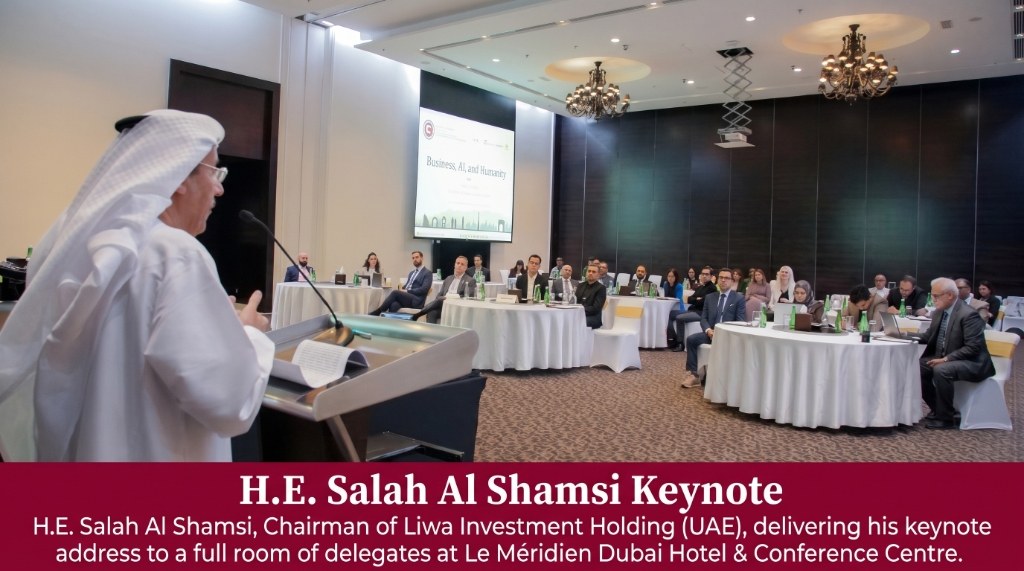
H.E. Salah Al Shamsi delivering his keynote address to a full room

H.E. Salah Al Shamsi (Chairman, Liwa Investment Holding, UAE) urged applying technology for value, through autonomous hospitals, refineries and buildings with a “super brain.” “Technology will not replace anyone; it will replace the lazy.” He asked universities to monetise research and to graduate people “who can think outside the envelope.”

“Technology will not replace anyone; it will replace the lazy.”

H.E. Salah Al Shamsi, Chairman, Liwa Investment Holding
Keynote Address · Day 1Le Méridien Dubai Hotel & Conference Centre
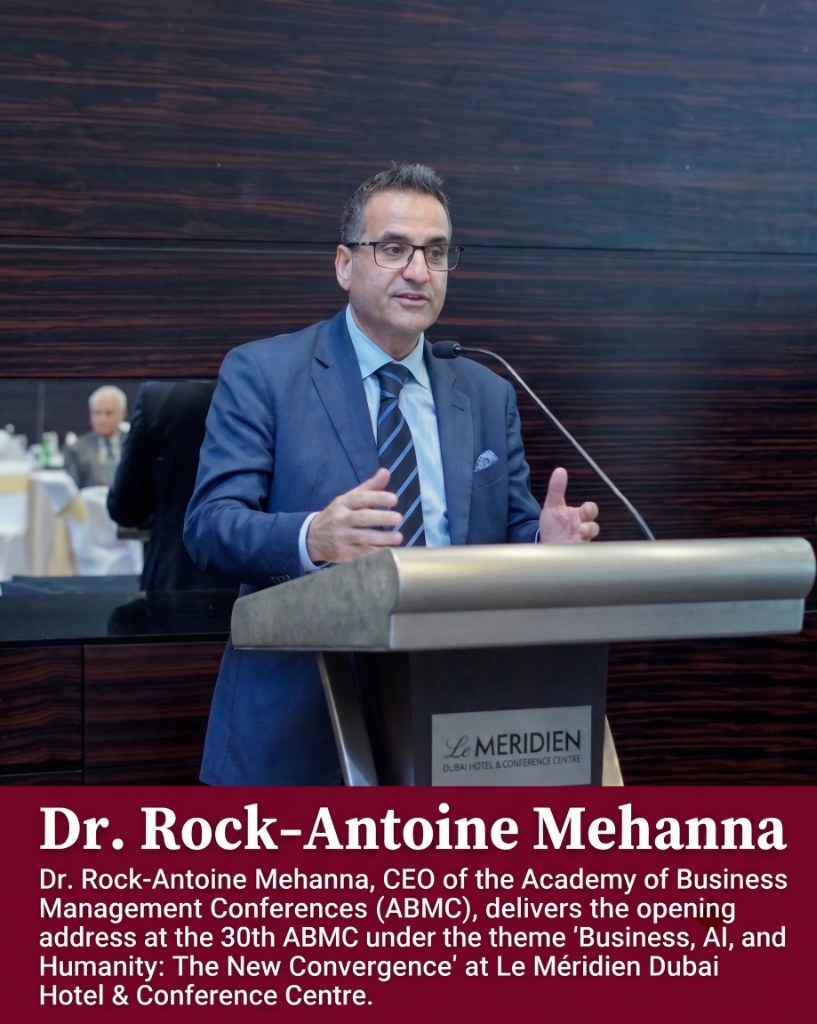
Dr. Rock-Antoine Mehanna, CEO, ABMC, opening the 30th edition

Dr. Rock-Antoine Mehanna (CEO, ABMC) opened the 30th edition with the conviction behind the series since 2010: “When academia and industry work together, nations rise.” Participants came from 29 countries and 54 universities. “AI is not coming. AI is here. The question is no longer whether machines will become more intelligent, but whether we will become wiser.” Citing the World Economic Forum’s projection of 170 million new jobs against 92 million displaced by 2030, he reframed the jobs debate: “The real question is who will prepare our people for the jobs AI creates.” He told the room: “Don’t just attend. Connect. Leave with a partnership, not just a photograph.” He thanked co-organiser American University in Dubai, knowledge partner Emerald Publishing, the conference chair and the organising offices in China, the UK and the UAE.

“When academia and industry work together, nations rise.”

Dr. Rock-Antoine Mehanna, CEO, ABMC
01 · Overview & Programme
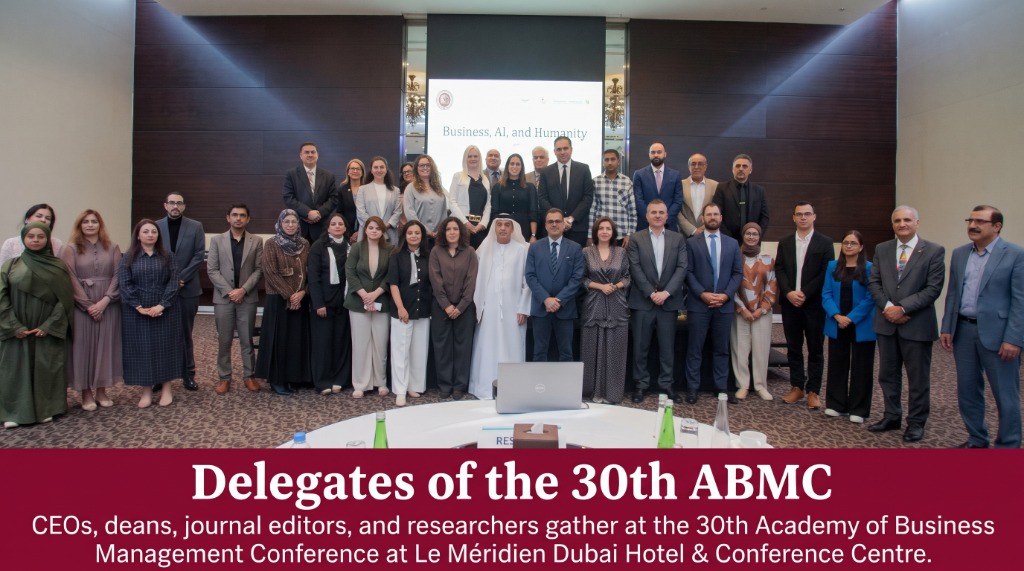
Delegates of the 30th ABMC at Le Méridien Dubai Hotel & Conference Centre
Overview

The 30th ABMC International Conference brought 200 participants to Dubai on 23-24 October 2026 under the theme “Business, AI, and Humanity: The New Convergence.” They included 20 CEOs, 20 business school deans and 10 editors of Scopus Q1-indexed journals, and 57 researchers presented their scholarly work over the two days.

ScheduleDay 1 (Friday 23 October)Day 2 (Saturday 24 October)
FormatIn person, Le Méridien Dubai Hotel & Conference CentreOnline (Zoom), then Dubai City & Global Village tour
ProgrammeOpening, 4 keynotes, CEOs, Deans and Editors roundtables, awards, Track I papersWelcome, Editors Roundtable II, 8 parallel paper sessions, closing
Collaborators
American University in Dubai (AUD)Emerald PublishingTalent NurturesTNEI Global
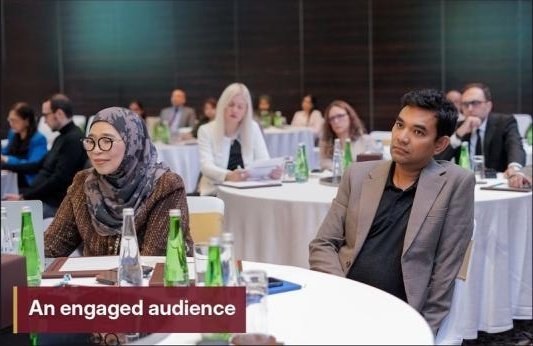
An engaged audience at the 30th ABMC
Where CEOs, Deans & Journal Editors Meet Researchers

Ideas, partnerships and publications that move business and academia forward, bringing together 29 countries and 54 universities in Dubai, UAE.

Participants praised the organisation; Dr. Judipat Obiora called the event “intellectually stimulating.”
02 · World-Class Keynotes · MIT & UCL
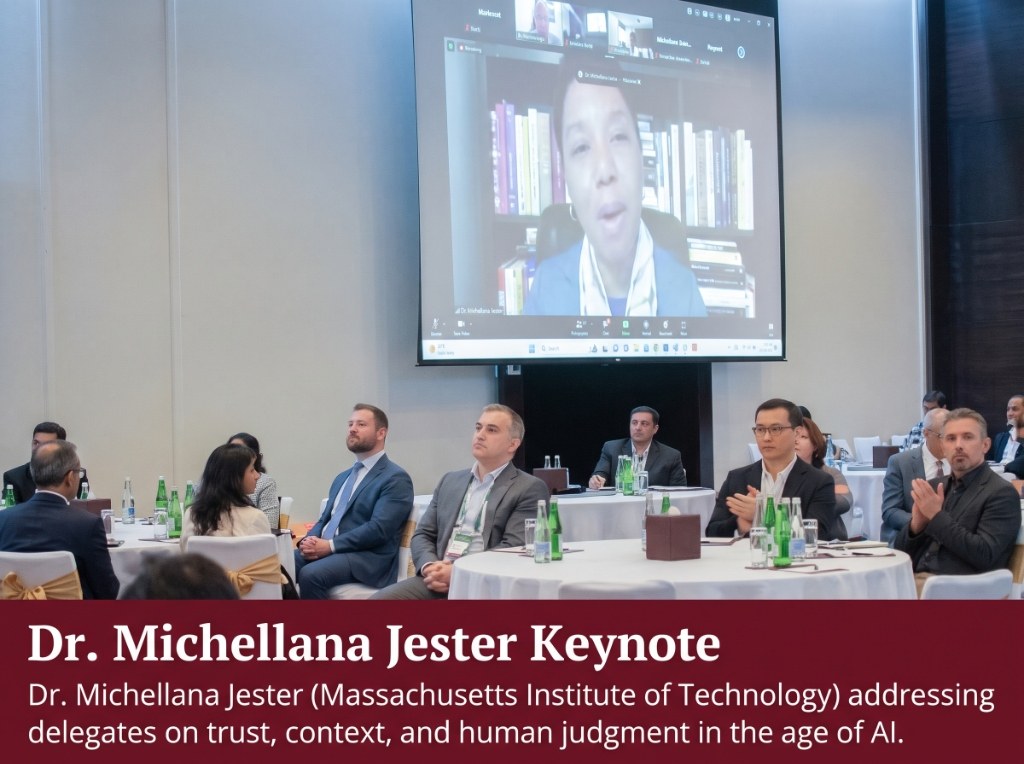
Dr. Michellana Jester Keynote, Massachusetts Institute of Technology (MIT)

Dr. Michellana Jester, Massachusetts Institute of Technology (MIT), set the tone: “AI makes answers abundant. What becomes scarce is human: trust, context and judgment.” In emerging markets, the model is a commodity and context is the moat. AI is “removing the bottom rungs of the ladder” and with them the struggle that builds judgment. She asked leaders where their 2036 leaders will learn judgment, editors what they certify when a polished manuscript costs nothing, and faculty whether they grade outputs or thinking.

“AI makes answers abundant. What becomes scarce is human: trust, context and judgment.”

Dr. Michellana Jester, Massachusetts Institute of Technology (MIT)
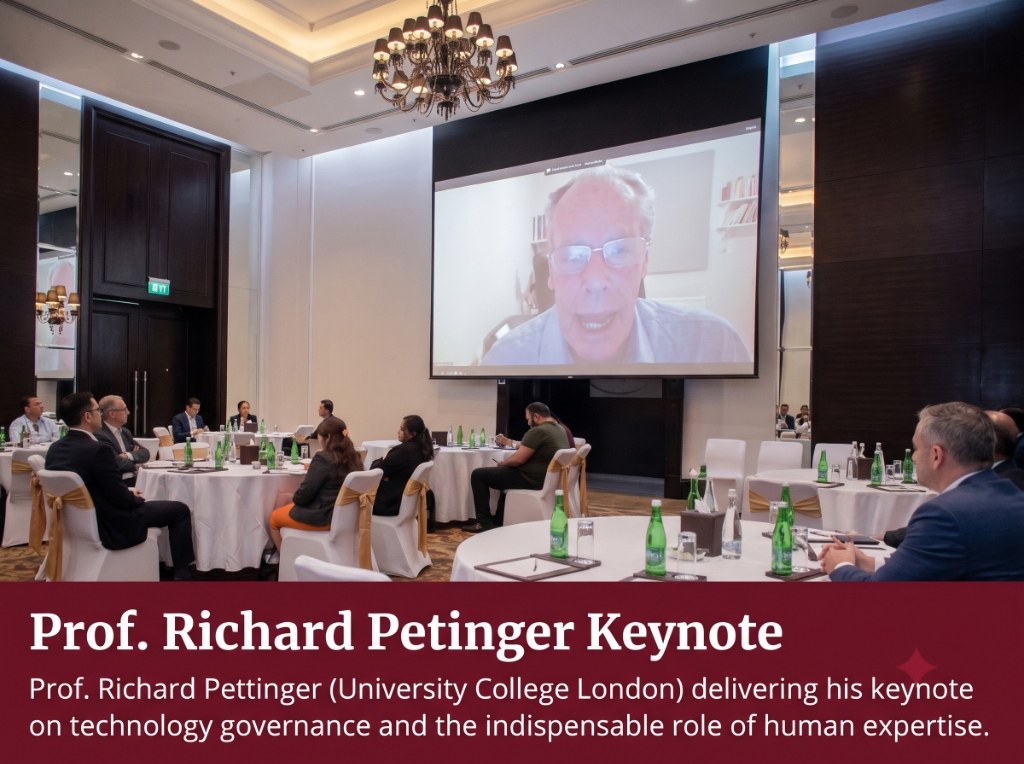
Prof. Richard Pettinger Keynote, University College London (UCL)

Prof. Richard Pettinger, University College London (UCL), cited three recent technology failures: hacked supermarket freezers in France, 32 UK government departments offline, and a possible university data leak. Without human expertise, “we don’t know whether we are building on rock or sand.”

“Without human expertise, we don’t know whether we are building on rock or sand.”

Prof. Richard Pettinger, University College London (UCL)
Keynote Speaker

Dr. Vijay Gerard D’Silva

Massachusetts Institute of Technology (MIT)

“The third wave, business-model reinvention, has yet to arrive.”

Dr. Vijay Gerard D’Silva, Massachusetts Institute of Technology (MIT), traced three corporate AI waves: personal productivity, process automation with humans in the loop, and business-model reinvention. That third wave, he said, has yet to arrive.

03 · Roundtables: CEOs · Deans · Journal Editors
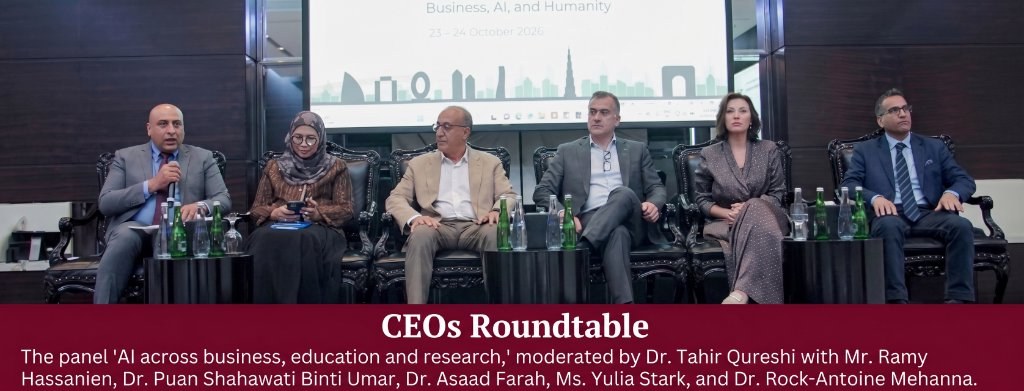
CEOs Roundtable: AI across business, education and research

Dr. Tahir Qureshi moderated the session and closed by saying AI must connect academia and industry, and that users must be trained.

Mr. Ramy Hassanien

Emerald Publishing

Publishers’ stance on AI has turned “completely the opposite” in a year, and AI is now embedded for search and discovery. Still, “human accountability is not negotiable.” Emerald backs impact beyond citations and runs free monthly author training for the region.

Dr. Puan Shahawati Binti Umar

Innovative University, Malaysia

Southeast Asia and the Middle East should combine the region’s speed and boldness with Asia’s diversity and affordability. “Don’t build a university the way you understand it. Build it for the future.”

Dr. Asaad Farah

American University in Dubai

Prepare faculty first and embrace AI “not as a cheating tool.” Grade how students prompt and refine AI. Only the MBA student who “used it smarter” scored 90.

Ms. Yulia Stark

European Women’s Association

AI “pushes you to be much more human.” Her UAE financial-literacy work showed that behaviour change needs relationships, and she urged CEOs to build the talent pipeline with universities.

Dr. Rock-Antoine Mehanna

ABMC

Some entry-level jobs will go, so universities must teach skills over knowledge. He proposed a chaebol- or keiretsu-style consortium linking industry, banks and universities to fund applied research on national priorities.

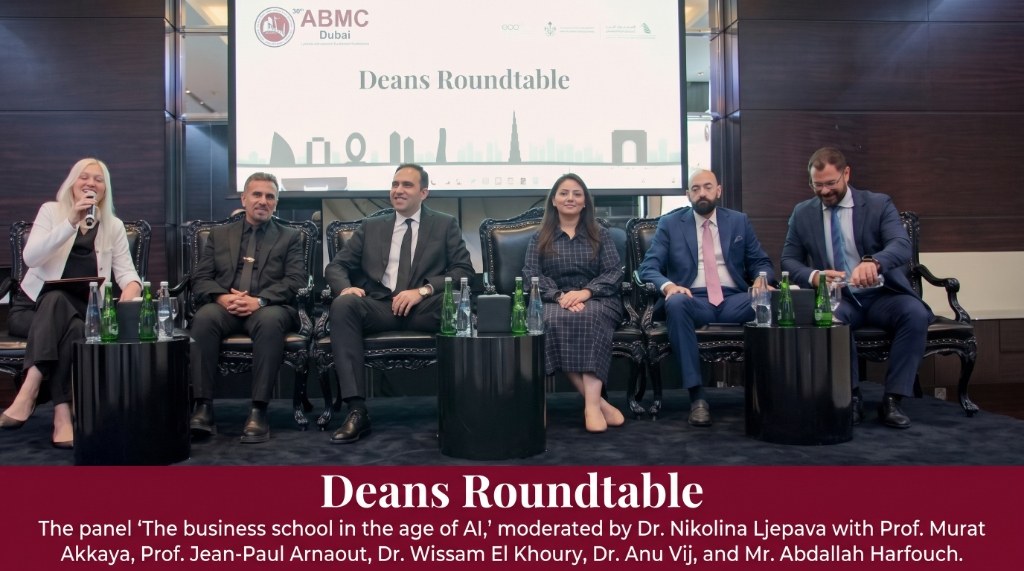
Deans Roundtable: the business school in the age of AI
Roundtable

Deans Roundtable: the business school in the age of AI

Moderated by Dr. Nikolina Ljepava (Dean, University of Khorfakkan), who warned against “outsourcing intelligence to AI.”

Prof. Murat Akkaya

Girne American University

“Knowledge is in our pockets.” The core skills are AI use, creativity and international collaboration, and curricula now change every semester.

Prof. Jean-Paul Arnaout

Abu Dhabi University

“If a chatbot could answer it, the assessment should change.” He sees the future school as “a boutique gym of human skills,” adding that “humans should never outsource what makes us different.”

Dr. Wissam El Khoury

AUD

“AI will replace people who can’t create value with it.” He has students challenge an AI board chair: “I don’t want to turn artificial intelligence into human stupidity.”

Dr. Anu Vij

EM Normandie, Dubai

“We cannot just coexist with industry; we must partner,” using live cases instead of “dead” textbook ones. “AI can give solutions, but it cannot take responsibility for the strategies that result.”

Mr. Abdallah Harfouch

EcoLearn & Alpha Universe Group

“The objective is transformation,” with universities and ed-tech firms as co-creators. He wants “AI that makes humans smarter, not dumber.”

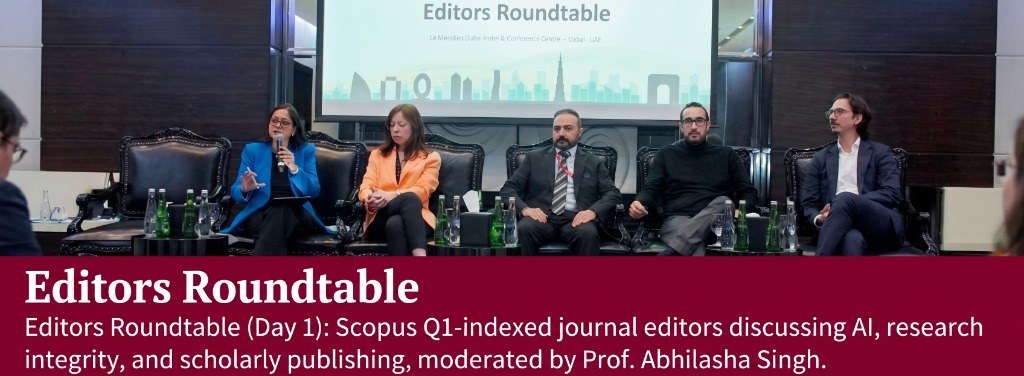
Editors Roundtable at the 30th ABMC
Day 1 (In Person)

Day 1 was moderated by Prof. Abhilasha Singh (Senior Editor, Journal of Applied Research in Higher Education). She noted that reviewers must not upload manuscripts to generative-AI tools.

Dr. John E. Katsos

EIC, Society and Business Review

“It’s naive to assume people aren’t using AI.” He has seen AI-fabricated quotations and treats AI detectors as unreliable. “The super-majority of papers have zero value. That’s our problem, not industry’s.” His advice: “Collect real data and do real research.”

Dr. Virginia Bodolica

EIC, Emerging Markets Case Studies

Her journal’s acceptance rate has fallen from 45% to 18% in the AI era. She wants practitioners on editorial boards and offers five Ps for strong cases: protagonist, problem, place, plot and paradigm.

Dr. Osama Khassawneh

Employee Relations

Industry doesn’t read journals, so partner with it early. Mixed methods and multi-source data make a manuscript stand out.

Dr. Mohamed Yacine Haddoud

IJEBR

Quantity-driven appraisal breeds “trivial papers to tick boxes.” “Pick the right journal. Don’t submit blindly.”

Day 2 (Online)

Day 2 (online) was moderated by the conference chair, whose takeaway was to use AI, but ethically and within limits.

Prof. Mark Anthony

The Service Industries Journal

“Success of AI in services should be measured not by how much we automate, but by how much value we create.”

Prof. Monica Violeta Achim

Humanities & Social Sciences Communications

Open access widens reach, but costs are rising. Uploading manuscripts to chatbots for review is “not ethical,” so build a niche and favour quality over citations.

Prof. Sherif Ismail

American University in Cairo

“If your idea is a finding, write an article; if it’s a conversation, build a book.” He added that “our regional context is not a limitation; it’s our competitive advantage.”

Prof. Daniel Balsalobre-Lorente

Evaluation Review

AI will automate the research process, so original ideas and human exchange at conferences matter “more than ever.”

04 · What We Learned & Scholarship

Key Takeaways

The conference reached one conclusion: AI makes answers cheap, so value moves to human judgment, context and the questions we ask.

01

Judgment is the new scarcity.

Expertise must be protected even as AI removes entry-level work.

02

Skills over knowledge.

Universities should update curricula every semester and use assessments AI cannot answer.

03

Partner, don’t coexist.

Industry and academia should co-create programmes and fund applied research on national priorities.

04

Publishing is under strain.

Submissions are surging and acceptance rates falling, so editors want real data and real problems.

05

Ethics demands human accountability.

Researchers should be transparent about AI use and should never hand a manuscript to a chatbot for review.

06

Regional context is an advantage

when it is framed in strong theory.

Scholarship

57 Research Presentations

57 researchers presented their scholarly work across nine sessions. These were Track I, held in person on Day 1, and eight parallel online sessions on Day 2.

Track I, chaired by Prof. M. Abdul Aziz Jumaa (Dean, Jumeira University), featured four papers:

Dr. Ritika Rathore: an AI-enabled Lean Six Sigma roadmap for hand-hygiene compliance.

Eshbayev Oybek: AI and university brand equity in Uzbekistan.

Dr. Dimitra Skandali: the agentic-AI paradox: “Trust in AI is not the same as authorising AI.”

Best Paper Award

Dr. Puan Shahawati Binti Umar: human-centred leadership across 168 Malaysian private universities. This paper won the Best Paper Award.

The eight parallel sessions were chaired by Dr. Zafar Mueen Nasir, Dr. Saif-Ur-Rehman, Dr. Marija Runic Ristic, Dr. Muhammad Suhrab, Dr. Muhammad Salman, Dr. Mahwish Sindhu, Dr. Waseem Irshad and Dr. Saša Drezgić.
05 · Recognition · Awards and Closing
Best Paper Award

Dr. Puan Shahawati Binti Umar, Innovative University, Malaysia

Excellence in Higher Education Leadership

American University in Dubai (received by Provost Dr. Asaad Farah)

Scholarly Publishing Impact Award

Emerald Publishing (received by Mr. Ramy Hassanien)

Concrete Outcome

The conference’s most concrete outcome is a new competition, with financial prizes, that Emerald will sponsor. Universities will submit business cases on how they are adapting curricula and faculty training to the AI era, and the winners will be published in Emerging Markets Case Studies.

Read In Report

“AI can help us work faster and smarter. People must remain at the heart of progress.”

Closing message, 30th ABMC

Presenters are invited to submit their papers to any of the 10 Scopus-indexed participating journals, citing the 30th ABMC. Certificates and proceedings will follow within a week, and the next ABMC is in 2027.

Thank You

See You at the Next ABMC · 2027

Thank you to every speaker, panellist, researcher, and delegate who made the 30th ABMC a success.